MEY LDC 500
Rev A · Dutch console channel strip
A preamp and a three-band EQ, modelled on the module that sat behind every fader in a Philips LDC recording console: the desks Philips built in the Netherlands in the early 1970s, some of them for nothing but classical recording. Two knobs of drive, three bands of shelf and peak, a high-pass, and a transformer's worth of colour that is simply always there.
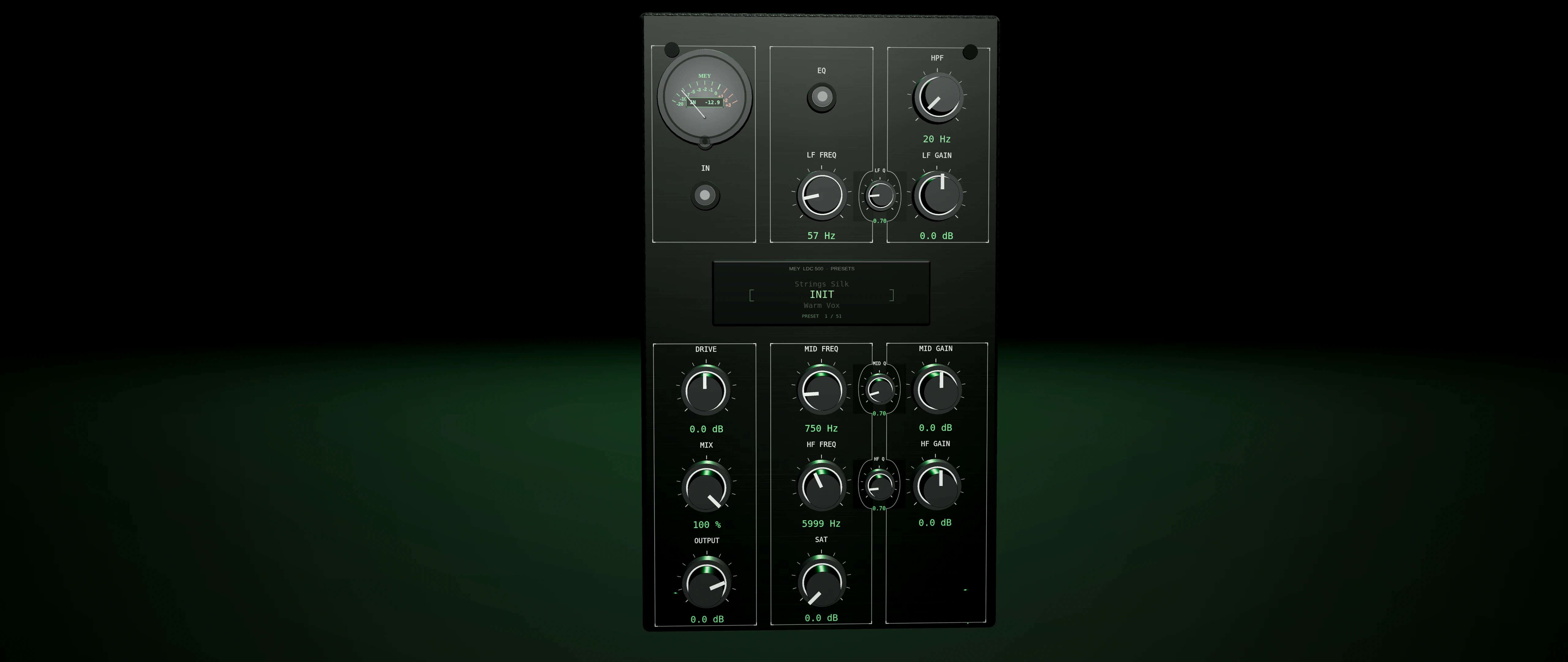
A plug-in built out of love for Dutch hardware
The Netherlands built proper recording consoles once. Philips did, in the same country that later gave the world the compact cassette and the CD, and almost nobody outside a handful of studios and broadcast trucks ever touched one. I grew up admiring that: hardware nobody talks about, built well, by people who cared how a channel sounded and not just whether it worked.
MEY LDC 500 is that admiration turned into a plug-in. Not a copy of one specific desk, and not a museum piece: a preamp and an EQ built the way that module was built, with the parts of it that mattered kept in, so the sound survives even though the consoles themselves mostly did not.
The Philips LDC consoles.
Philips built its own recording consoles in the Netherlands from around 1970: the LDC line, in a handful of sizes (the LDC 12, 15 and 25, the number being roughly how many input channels the frame carried). Some were built specifically for classical recording, others went into broadcast trucks and studios, and by most accounts that survive they were taken seriously well outside Philips' own walls: engineers who worked on them describe a sound that was punchy and clean, spoken of in the same breath as the Neve, API and Studer desks of the same years.
Each channel was built from separate modules you could pull and swap: a preamp and three-band EQ module first, with limiter and compressor modules following later as the line matured. That is the part of an LDC desk this plug-in is actually modelled on, the module every signal passed through before it ever reached a fader.
The record of exactly who used which desk where is thin, the way it is for most broadcast-owned hardware from that era: logged in session sheets nobody kept, not in liner notes. What is well documented is the Dutch classical recording tradition that Philips maintained alongside its hardware, with engineers like Hans Lauterslager, who spent four decades at Philips from 1952, recording Mahler's Eighth in 1954, working at Bayreuth from 1961, and sitting behind conductors like Bernstein, Haitink and Böhm. That is a separate legacy from the LDC console specifically, and the two should not be collapsed into one story, but they grew out of the same house.
A preamp, then an EQ, in that order.
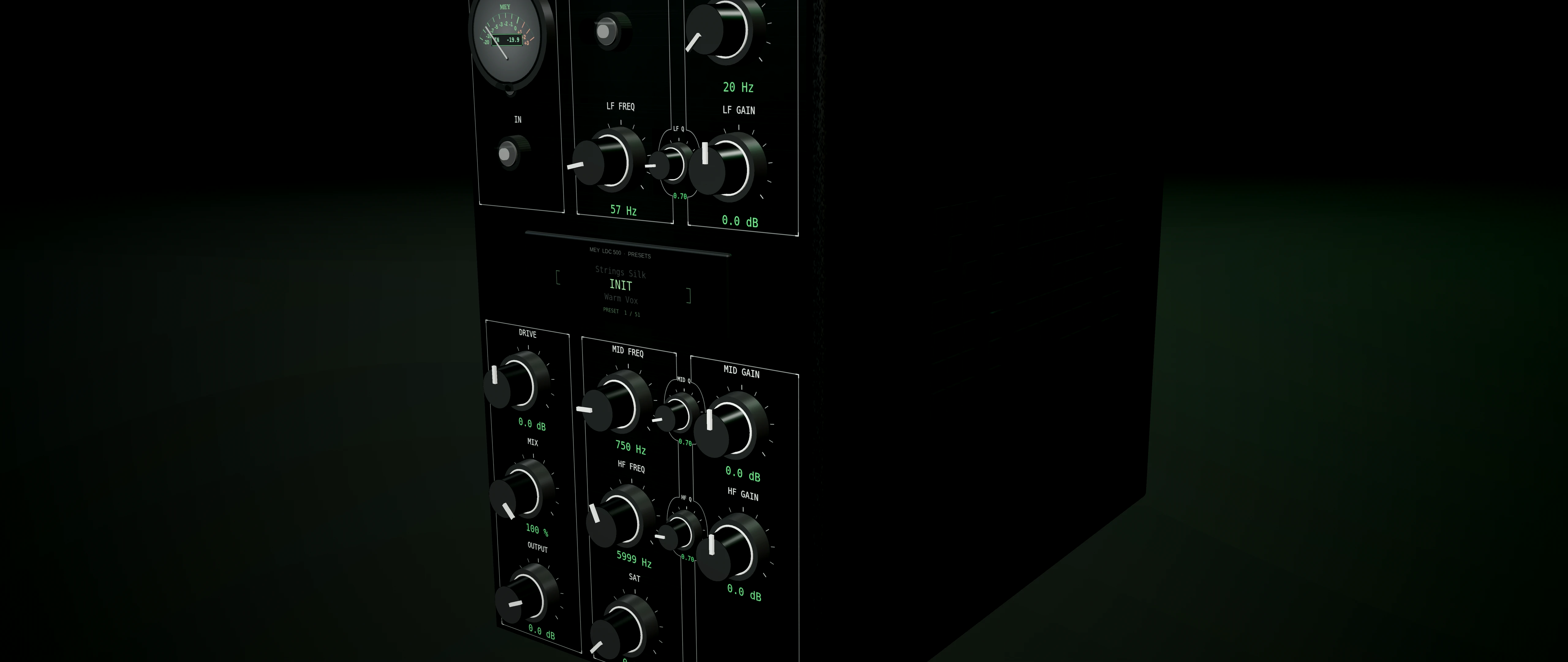
MEY LDC 500 is two sections in series, the way the real module was wired. The preamp comes first: an input trim, an output trim, and a saturation stage built around the same iron a real transformer would put in the signal path, rather than a plain digital gain. After it, a high-pass and a three-band EQ, low and high as shelves, mid as a bell, each with its own frequency and its own bandwidth, plus a dedicated saturation knob in the EQ itself.
Nothing here is a preset emulation of one fixed circuit. Every band is fully sweepable, the bandwidth on all three is adjustable rather than fixed, and the preamp's drive runs from a whisper of colour to something you can hear working. What is fixed is the character underneath it, the small, constant colouration that a transformer-coupled circuit puts on everything that passes through it, whether you are pushing the drive or leaving every knob at zero.
The colour that never turns off.
Most of what makes an EQ sound "musical" rather than surgical is not the curve you draw, it is what happens to the signal in between the curves. LDC 500 has three things going on, stacked underneath whatever you dial in.
First, the preamp's saturation. Driving it does not clip: it runs the signal through a soft, transformer-style curve that adds mostly odd-order harmonics with a touch of even-order mixed in, the combination that reads as warmth rather than grit, and above that it leans on a soft ceiling rather than a hard one, so a peak that would clip a plain digital gain stage simply rounds off instead.
Second, a small high-shelf lift above roughly 14 kHz that is always active, on every signal, regardless of what the EQ bands are doing. It is a fraction of a decibel, modelled on the way a real output transformer opens the top end slightly rather than passing it flat. You are not meant to hear it as an effect. You are meant to miss it if it is gone.
Third, the SAT knob inside the EQ section itself, separate from the preamp's own drive: a second, independent saturation stage sitting between the mid and high bands, for adding grit to the top end of a sound without touching how hot the front of the channel runs.
All three are the same family of curve underneath, the kind of soft, self-limiting saturation a transformer-coupled circuit produces on its own, applied in three different places for three different reasons.
What the numbers actually say.
Robbie's oscillators get measured. So does this. A full-scale 1 kHz tone through the preamp, drive from off to maximum: total harmonic distortion climbs smoothly from about 0.01% with the drive closed to roughly 1.5% flat out, dominated by third harmonic with a smaller second-harmonic component riding underneath it, never a sudden jump. That is the shape a transformer-style stage is supposed to have: distortion that grows with how hard you push it, not a wall you hit.
| THD @ 1 kHz, drive at minimum | ≈ 0.01%, essentially transparent |
| THD @ 1 kHz, drive at maximum | ≈ 1.5%, third-harmonic-led warmth, no hard clipping |
| Always-on top shelf | +1 dB above ≈ 14 kHz, fixed, present at every setting |
| Soft ceiling | Engages gently above +30 dB headroom, tanh knee, never a hard wall |
| High-pass | Two-pole, 20 Hz by default, sweepable to 300 Hz |
Every EQ band is fully continuous rather than stepped, each with its own bandwidth control: low and high shelves from a broad, gentle slope to a tight, almost surgical one, and the same for the mid bell. Nothing here is a fixed curve wearing a knob for decoration.
| Preamp | Input and output trim, ±18 dB in · −18/+6 dB out · transformer-style saturation |
| High-pass | Two-pole, 20 Hz default, sweepable to 300 Hz |
| Low band | Shelf, 40 Hz–700 Hz, ±15 dB, continuously variable bandwidth |
| Mid band | Bell, 500 Hz–7 kHz, ±15 dB, continuously variable bandwidth |
| High band | Shelf, 3.2 kHz–15 kHz, ±15 dB, continuously variable bandwidth |
| SAT | Independent saturation stage between mid and high bands |
| Character | Fixed high-shelf lift above ≈14 kHz, present at every setting |
| Presets | Save, browse and step through with the panel's own preset bar |
An installer, and nothing to decide.
On macOS, double-click the installer: the VST3 goes to ~/Library/Audio/Plug-Ins/VST3, the Audio Unit to ~/Library/Audio/Plug-Ins/Components and the standalone app to Applications. On Windows, run the installer: the VST3 goes to C:\Program Files\Common Files\VST3 and the standalone to Program Files with a Start menu entry. Rescan in your host, load a channel, and drive the preamp harder than feels reasonable.
Know someone who'd use this?
MEY LDC 500 is free. Sharing it with someone who mixes or masters is the fastest way to help.