TIJN 50
Fifty Year Anniversary Model
A filter and drive effect, built as a birthday present and free for everyone from 1 October. Two filter slots, five circuit models each, fed hot enough that the filter's own saturation is the distortion, with the cutoff able to move at audio rate. There is no separate distortion stage, because a filter driven twenty decibels too hard is a better sound than a clean filter followed by a waveshaper.

Happy 50th
Half a century on this earth, and a good chunk of it spent chasing the hardest kicks and the dirtiest basslines Dutch soil ever produced.
Long before “producer” was a job title people put on LinkedIn, you were in the booth writing, arranging and pressing records under more names than most people have had hot dinners: E. Engbrenghoff, M. Engbrenghof, Engbrengoff, take your pick, the vinyl never quite agreed on the spelling but it always agreed on the sound.
E-Rick & Tactic tearing up Thunderdome with “Hardcore Rules The World.”
Raw, relentless, and built to be played way too loud.
Fifty years old and still, somehow, the same guy who’d rather argue about a snare sample than small talk about the weather. That’s not a small thing. That’s a life spent caring about the right things.
Martijn, we’ve been friends for more than 25 years now, and something tells me the next 25 will look a lot like the last: us, old and grey, sitting behind the geraniums, still complaining about badly recorded music.
Here’s to you, brother.
A filter you are supposed to drive too hard.
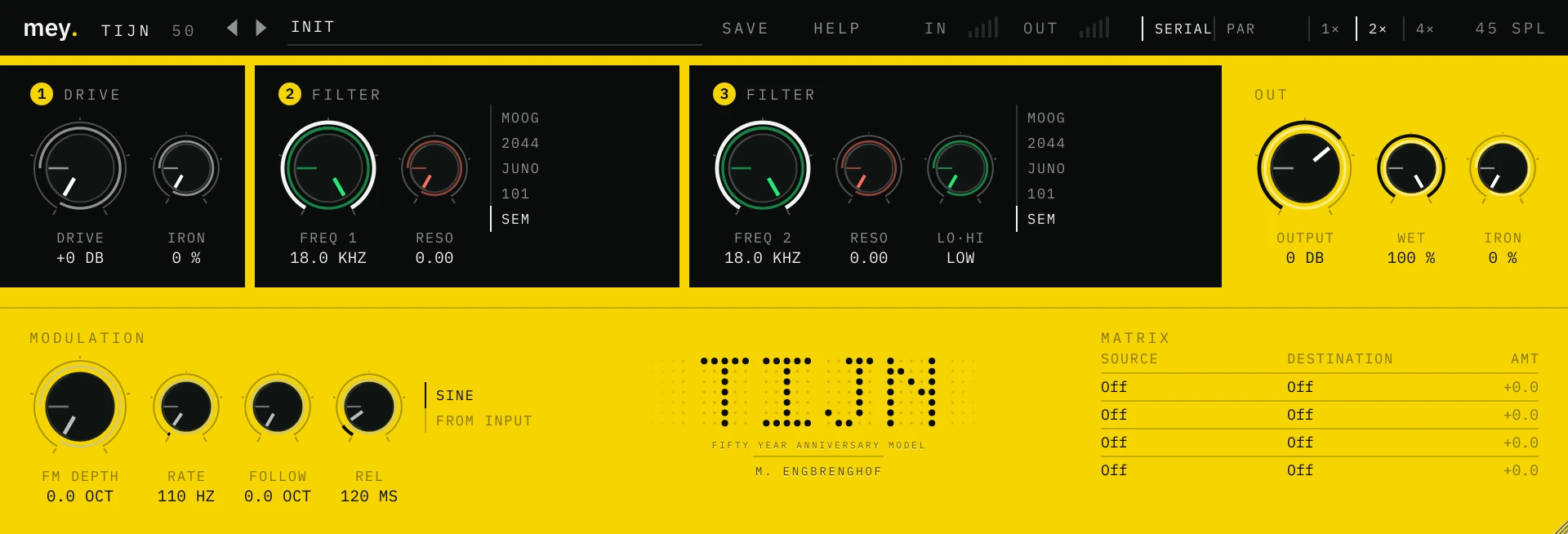
Two filter slots, each one a model of a real circuit, with a drive stage in front of them and a transformer at either end. The distortion is not a separate box after the filter: it is the filter, limiting on its own resonance path, which is why the circuit models had to be nonlinear before any of this was worth building.
It opens as a wire. Both filters sit wide open with no resonance, no drive and no iron, so putting it on a track changes nothing until you do. The signal runs left to right and the plate darkens as it goes: three fields cut out of the yellow, numbered one, two and three, then the output back on the plate itself. Green is always frequency, red is always resonance, white is always level. Nothing moves when you change anything.
Five circuits, not five settings.
Each one is modelled from its own schematic or data sheet, and the differences between them were measured rather than chosen.
| MOOG | Transistor ladder. The feedback is subtracted from the input, so it loses its bottom end as the resonance comes up. That loss is the sound. |
| 2044 | Dave Rossum's ladder, as in the SSM2044. The feedback arrives as a current into a node held at ground, so the input is not attenuated and the filter keeps its weight. |
| JUNO | OTA integrator cascade: the Roland IR3109 with the Juno's own feedback circuit around it. |
| 101 | The same chip with the SH-101's discrete phase splitter instead, which is why a Juno and an SH-101 do not sound alike. |
| SEM | State variable, and the only one that is not four poles. Twelve decibels an octave, and a continuous fader from lowpass through notch to highpass. |
Two octaves below the cutoff, with the resonance up, the five sit fourteen decibels apart: the Moog at minus twelve, the 101 at minus eight, the Juno at minus two, the 2044 at plus two and the SEM flat. That spread is the point, so it is left exactly where the measurement found it. Only above a peak of twelve decibels is anything held, so that changing circuit does not change how loud the plug-in is.
Every circuit oscillates near the top of its resonance control, and not all of them at the same place: measured, the two ladders let go at 0.89, the Juno and the 101 at 0.93, and the SEM, the shallowest of the five, holds on until 0.96. Past that point the filter is making its own tone and the frequency control is tuning it. SERIAL sends the first filter into the second; PAR runs both from the same input and adds them, which is how you get two resonant peaks at once, or a band split with one slot low and the other high.
Forty decibels in, and a transformer at each end.
DRIVE is the gain into the filters, up to forty decibels, in whole steps. The output takes most of it back but not all: a box that gets a little louder as it is driven is a box people reach for, and taking all of it back makes the control feel dead.
IRON is a transformer model, one on the way in and one on the way out, and it is not a waveshaper. The flux in a core is the integral of the voltage across the winding, and saturation is a property of the flux, so the same level makes about twenty times more flux at fifty hertz than at a kilohertz. Iron therefore colours the bottom and leaves the top alone. The magnetising current the core draws once it saturates loads the source and pulls the winding voltage back down, and that loop is closed rather than assumed, so the bottom end gets quieter as the iron works instead of louder.
Measured with the knob at its end and a full-scale sine on it, which is the hardest thing anybody can ask of a transformer: the third harmonic sits at minus thirteen decibels at 50 Hz and the tone itself loses three and a half, minus forty at 200 Hz, and nothing at all at 1 kHz. The control covers everything below that, and it moves with how hard you hit it as much as with where you set it. Total distortion at 50 Hz against input level: twenty-three percent at zero dBFS, fourteen at minus six, three and a half at minus twelve, two tenths of a percent at minus eighteen. At 200 Hz and above it stays under two percent wherever the knob is.
One control, two jobs. Where most material sits it is weight on the bottom and nothing at all on the top, which is what a transformer is for and what a waveshaper cannot do, having no core to integrate into. Wound up on something loud and low it stops being a colour and becomes the effect, and that is the point: this is a box built to be driven too hard, and the iron was given the range to go there with it. At zero it returns the sample unchanged, bit for bit.
A follower, audio-rate FM, two LFOs and a matrix.
FOLLOW opens both cutoffs with the level of what comes in, up to six octaves, and RELEASE is how fast it closes again. The rise is always fast, because that is what makes a box follow a drum instead of chattering at it.
Opening a lowpass upward only adds whatever the material had up there, so how much louder it gets depends on the signal rather than the setting. That is compensated for musical material: turn FOLLOW from nothing to its maximum on a mix and the level stays inside a decibel or two. On genuinely broadband material, hats and noise sweeps, it does still get louder, and that is a filter opening rather than a fault.
FM DEPTH moves the cutoff up to five octaves at a rate from a tenth of a hertz to eight kilohertz. Below about twenty hertz that is a wobble. In the hundreds the filter starts generating sidebands of its own, metallic and rude, and that is the sound this whole category is bought for. The source is a sine of its own or the incoming signal, which turns the box into something that argues with the material rather than decorating it.
The matrix is four slots, each a source, a destination and an amount from minus one to plus one. Sources are the follower, an envelope that jumps per hit, and two LFOs that run free or lock to the host from four bars down to a thirty-second. A modulated control shows it: the knob grows a second, thinner pointer at the value the filter is actually using.
Measured, not assumed.
Moving a cutoff at audio rate makes sidebands on purpose, and the ones that land above half the sample rate fold back into the middle of the music at frequencies that have nothing to do with the note being played. With the FM off, the drive and the filters' own saturation fold back at minus a hundred and fifteen decibels or quieter on four of the five circuits, so oversampling is not needed for that at all.
| 1× | −34 to −74 dB below 18 kHz, depending on the circuit. All it needs with the FM off. |
| 2× | −53 to −88 dB. The default, and it covers everything up to and including deep FM. |
| 4× | −76 to −89 dB. For deep FM with the resonance high, and up to twenty-three decibels quieter than 2× where it counts. |
Oversampling costs latency and the number of samples is printed at the right of the black bar: none at 1×, forty-five samples at 2×, fifty-two at 4×. The host is told, and the dry path is delayed to match exactly, measured sample for sample, so the wet control is a mix and never a comb filter.
Fifty-six places to start, and a right-click to learn.
Fifty-six presets in nine groups, in the black bar at the top, stepped with the arrows or picked from the menu. Right-click any control and choose MIDI learn, then move a knob on your controller: the next message it sends owns that control, and the map is saved beside the presets. The whole manual is inside the plug-in behind HELP, so there is nothing to look up and nothing to keep in a folder.
You can hear every one of them before it ships. The whole bank is on this site, on a drum loop or a synth line, rendered straight from the plug-in rather than recorded.
| Filters | Two slots · five circuit models each · serial or parallel |
| Circuits | Moog ladder, SSM2044, Juno IR3109, SH-101, SEM state variable |
| Slopes | 24 dB per octave on four of them, 12 dB and continuous LP–notch–HP on the SEM |
| Drive | 0 to 40 dB into the filters, in whole steps |
| Iron | Transformer model at input and output, frequency dependent by construction |
| Movement | Envelope follower · audio-rate FM to 8 kHz · two LFOs, free or host-synced |
| Matrix | Four slots · signed amounts · modulation shown on the knob |
| Oversampling | 1×, 2× or 4× · latency reported, dry path delayed to match |
| Internals | Double precision through the filters and the drive |
| Presets | Fifty-six in nine groups · MIDI learn on every control |
| Version | 1.0.0 |
A signed installer, no choices to make.
On macOS, double-click the installer. It places the VST3 in ~/Library/Audio/Plug-Ins/VST3, the Audio Unit in ~/Library/Audio/Plug-Ins/Components and the standalone in Applications. On Windows, run the installer: the VST3 goes to C:\Program Files\Common Files\VST3 and the standalone to Program Files with a Start menu entry. Restart your DAW or rescan, load a preset, and turn DRIVE up further than feels reasonable.
Free, and Martijn gets it first.
TIJN 50 was built as a fiftieth birthday present, and the plate says so: the engraving under the wordmark reads Fifty Year Anniversary Model, M. Engbrenghof. That engraving stays. He gets the first copy, by hand, on a stick.
On 1 October it goes out to everyone else, free, for macOS and Windows. Leave your address at the top of this page and you get one email on the day, with the two download links in it and nothing else. No account, no licence key, nothing to log into.
Know someone who'd use this?
TIJN 50 is free. Sharing it with someone who mixes or masters is the fastest way to help.