For years, in conversations with recording engineers, before a session, after one, sometimes over a drink long after the gear was packed away, one complaint kept coming back. Not about any single plug-in. About reverb as a category.
"It sounds fine," someone would say, "but it doesn't sound like anywhere."
That's the whole problem in one sentence. Most reverb, however good the algorithm, is a wash. You turn a knob, a tail appears, and the tail is a shape: an envelope, a density curve, a diffusion setting. It turns the reverb on, and that's where the thinking stops. It never actually asks the question a room asks every time a sound moves through it: how big is this space, what are the walls made of, how many people are standing in it, is the air warm or cold, dry or damp. A convolution impulse captures one answer to that question, frozen at the moment it was recorded, in one room, from one microphone position. Everything else is interpolation.
What the engineers I kept talking to actually wanted was simpler and harder at the same time: a reverb that behaved like a room, not one that imitated the sound of having recorded in one.
What they were actually asking for
Nobody used those exact words, obviously. It came out sideways, in specifics. Someone wanting a choir recording to sit in a slightly smaller hall without reaching for a different plug-in entirely. Someone wanting to move a virtual microphone six inches back from the source and hear the early reflections actually change, not just the wet level. Someone wanting a damp, occupied hall on a Tuesday matinee to sound different from an empty one at soundcheck, because in real rooms it does.
None of that is a preset request. It's a request for a model: a room built from real variables, not a library of frozen snapshots you scroll through hoping one is close enough.
So I built a room, not a reverb
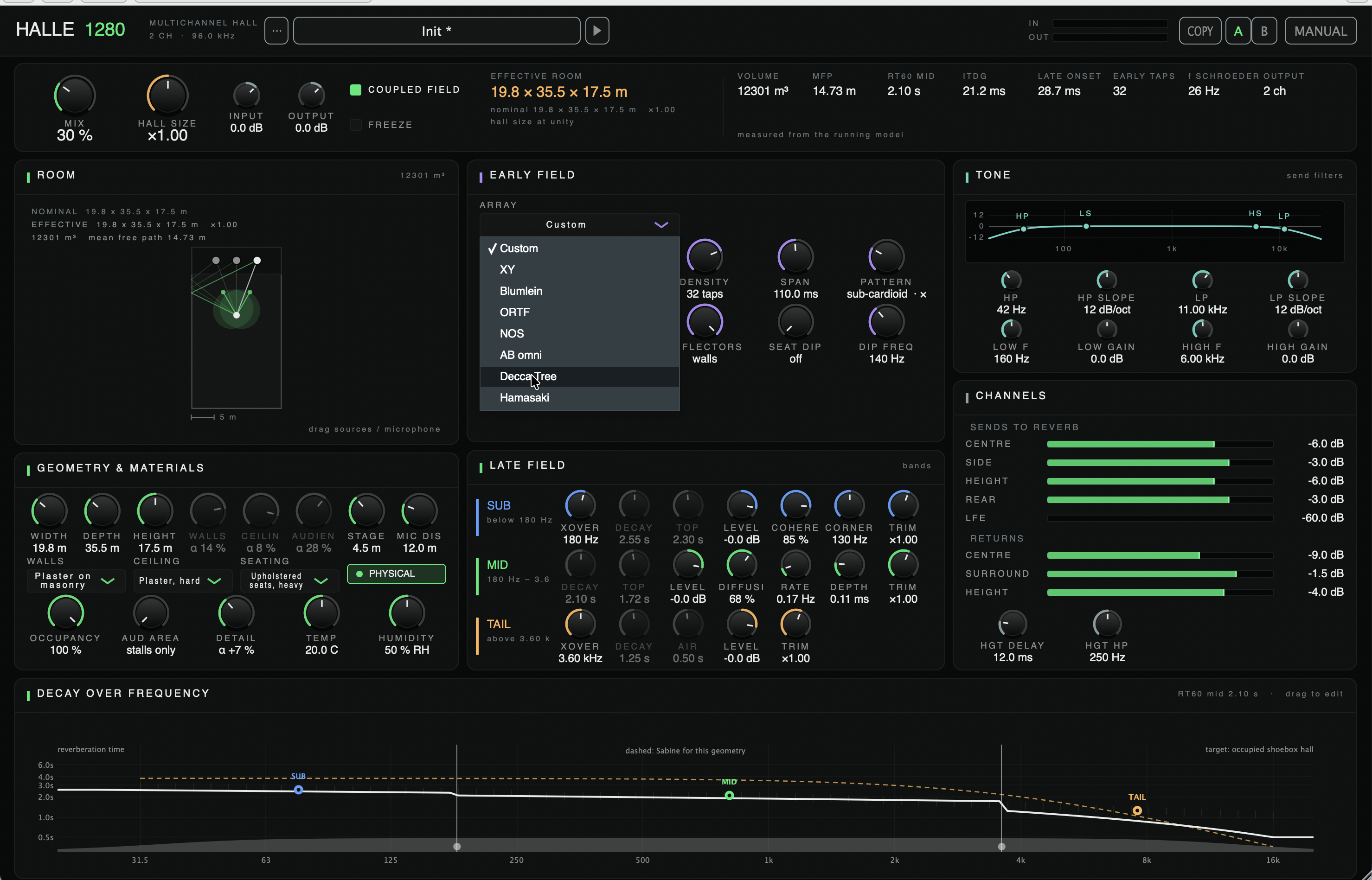
HALLE 1280 doesn't store an impulse. It computes one, continuously, from a physical description of a space: width, depth and height in metres, wall and ceiling material, how full the room is and where people are sitting, air temperature and humidity. From that description it derives what a real room would actually produce: its volume, the mean free path a reflection travels between surfaces, RT60, the initial time delay gap, when the late field takes over, the Schroeder frequency where the room stops behaving like discrete reflections and starts behaving like a continuous field. Move WIDTH or WALLS or HUMIDITY and those numbers update in real time, because they're not readouts, they're the room actually changing.
The early reflections come from a choice of real recording-technique microphone arrays, XY, Blumlein, ORTF, NOS, AB omni, Decca Tree, Hamasaki, or a custom pattern built from the remaining controls, so the front of the sound is shaped the way a real recording decision would shape it, not by a generic "early reflections" slider. The late field splits into three independently decaying bands, sub, mid and tail, because a real room doesn't decay at one uniform rate across the spectrum, and forcing it to was always the tell that gave synthetic reverb away.
None of this is a claim that HALLE 1280 is more correct than the reverbs that came before it. Plenty of excellent reverbs exist, built on convolution, on algorithmic design, on decades of careful tuning, and they do exactly what they were built to do. I design differently because a modelled room is what actually serves the sessions I work on: matching a choir to a slightly smaller hall without switching plug-ins, moving a mic array and hearing the early reflections genuinely change, hearing a hall breathe differently between an empty room and a full one. HALLE 1280 is one answer to one specific, repeated request: give me the room, not just its echo.
Why it's free
HALLE 1280 is the first release built this way, and I want it out in real sessions rather than sitting behind a price while it finds its footing. It's free, first release, no account. If it earns a place in your work, tell me how you're using it and, if you're willing, share the track it's on. I'd genuinely like to hear it. And if it's given you something worth saying, a review helps the next engineer looking for exactly this find it.
Ronald MEY Audio Engineering